
Marcus had his Berkeley garage floor coated three years ago. Looked great for about eighteen…
Epoxy Flooring Warrawong: Humidity-Resistant Solutions for Coastal Conditions
Dave had done everything right.
He’d researched epoxy flooring for months before calling a contractor. He chose what seemed like a quality product. He cleared out his Warrawong garage, moved the cars onto the street for two days, and waited patiently while the crew laid down what was supposed to be a durable, long-lasting floor.
Eight months later, the surface was bubbling near the back wall. By month twelve, sections were peeling up like sunburned skin.
The problem wasn’t Dave’s research. And it wasn’t the contractor cutting corners — at least not intentionally. The problem was that standard epoxy products weren’t built for what Warrawong throws at a concrete slab every single day: persistent coastal humidity, salt-laden winds rolling in off the Tasman Sea, and ground moisture that never really stops moving upward through the slab.
This is one of the more common stories we hear from homeowners and facility managers across the Illawarra region. And it’s why choosing the right epoxy flooring Warrawong system — one that’s been specifically engineered for coastal humidity — makes all the difference between a floor that lasts a decade and one that fails before the warranty even kicks in.
In this article, you’ll learn exactly how moisture vapour transmission works, which primer systems actually prevent failure in high-humidity coastal environments, and what to ask a local contractor before you sign anything.
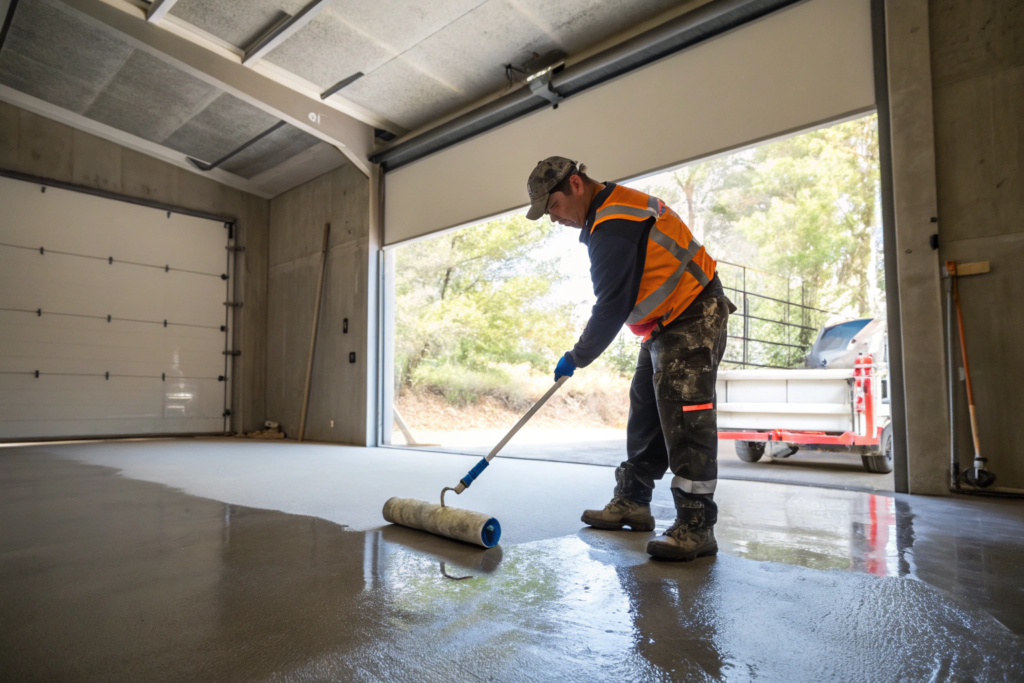
Can Epoxy Flooring Withstand Coastal Humidity in Warrawong?
Yes — but only when the right system is chosen for the conditions. Standard epoxy products sold at hardware stores or used by contractors without coastal experience can fail quickly in Warrawong’s humid, salt-heavy environment. Blistering, bubbling, and full delamination are common outcomes when the product specification doesn’t match the substrate conditions.
When the right system is installed correctly, epoxy flooring performs exceptionally well in coastal areas like Wollongong’s Illawarra region — lasting ten years or more with minimal maintenance.
For coastal epoxy to succeed in Warrawong, five things need to happen:
- Moisture vapour transmission (MVT) testing must be done before any product touches the slab — skipping this step is the number one reason floors fail
- A penetrating epoxy primer rated for high-humidity substrates needs to go down first, not just a standard sealer
- A salt-air resistant topcoat with UV stability is needed to handle Warrawong’s onshore wind exposure
- The concrete surface profile (CSP) must sit between 3 and 4 — anything less and the epoxy simply won’t bond properly to a coastal slab
- Installation needs to be scheduled around Wollongong’s humidity and temperature windows — putting epoxy down on a 90% humidity day is a recipe for failure regardless of product quality
Get these five things right, and coastal epoxy flooring isn’t just possible in Warrawong — it’s one of the most practical and durable flooring options available for garages, industrial facilities, and commercial spaces near Port Kembla.
How Coastal Humidity Affects Epoxy Flooring Performance
Most people think of epoxy as a surface problem — prep the concrete, apply the product, done. But in Warrawong, what’s happening beneath the slab matters just as much as what goes on top.
Wollongong’s Humidity Profile — What the Data Shows
According to the Bureau of Meteorology, Wollongong sits between 75–85% relative humidity annually. Add prevailing onshore winds pushing salt air in from the Tasman Sea, and you’ve got an environment that quietly works against standard coatings year-round. Port Kembla’s industrial coastal microclimate makes conditions even more challenging — fluctuating ground temperatures and constant water proximity mean concrete slabs here behave differently to slabs in drier inland suburbs.
The Science of Moisture Vapour Transmission (MVT)
Concrete slabs aren’t sealed systems. Ground moisture moves upward through the slab constantly — this is called moisture vapour transmission, or MVT. In coastal Warrawong, that process is accelerated because surrounding soil holds more moisture and humidity stays high. When epoxy goes over a slab with elevated MVT, that rising moisture gets trapped beneath the coating. Blistering and delamination follow.
Why Standard Epoxy Products Fail Near the Coast
Standard epoxy is formulated for average conditions. Warrawong isn’t average. When the wrong product meets a coastal slab, the adhesion bond weakens at the concrete interface. Bubbles appear first, usually near walls or drains. Then sections start lifting. It’s not a defective product story — it’s a wrong-product-for-the-environment story that plays out regularly across Warrawong, Fairy Meadow, and Unanderra.
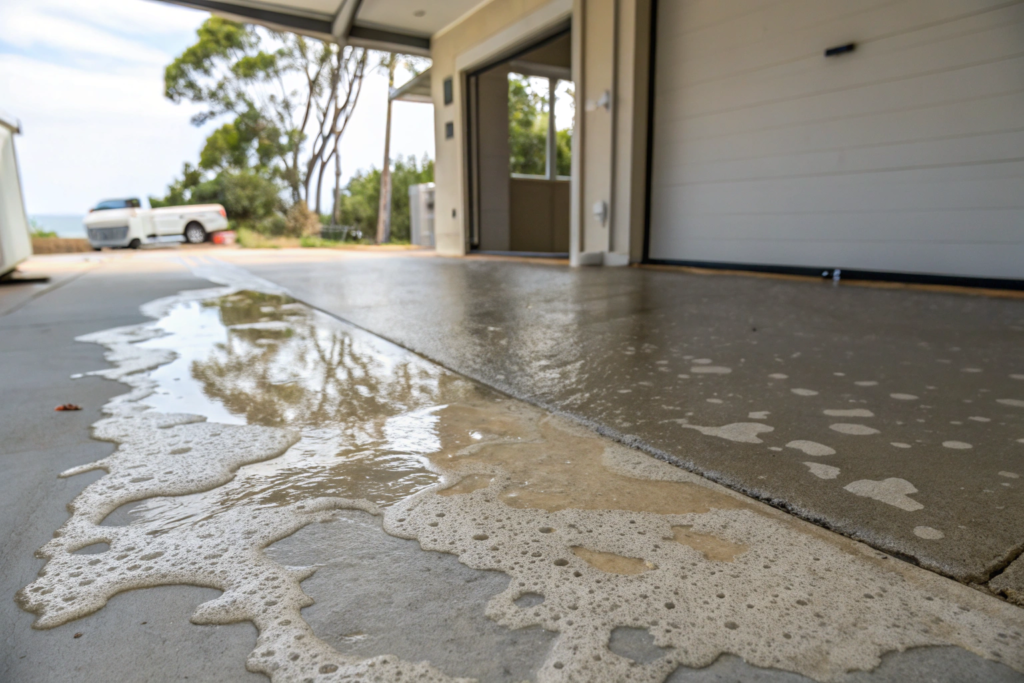
Moisture Vapour Transmission Testing in Warrawong Industrial Facilities
Before any epoxy flooring system goes down in a coastal environment, the slab needs to be tested. Skipping this step is the single biggest reason industrial epoxy flooring Warrawong installations fail within the first year.
What is MVT Testing and Why It Matters Before Installation
Two methods are used: the calcium chloride test measures surface moisture over 72 hours, while relative humidity probes measure moisture levels inside the slab itself.
Acceptable MVT Thresholds for Coastal Concrete Substrates
Most standard epoxy systems are rated for slabs up to 3–5 kg/m²/24hrs. Coastal slabs in Warrawong regularly come back above that threshold — and when they do, product selection changes significantly.
| MVT Reading | Risk Level | Recommended System |
|---|---|---|
| Under 3 kg/m²/24hr | Low | Standard epoxy primer |
| 3–5 kg/m²/24hr | Moderate | Moisture-tolerant primer |
| Above 5 kg/m²/24hr | High | Two-part moisture barrier system |
How Local Conditions in Warrawong Affect Your MVT Results
Seasonal variation, tidal influence, and slab age all shift readings. Experienced local contractors test accordingly — never assuming one result holds year-round.
Case Study — Port Kembla Industrial Facility
Two failed installs in four years — both contractors skipped MVT testing. Our team recorded 6.2 kg/m²/24hr, specified a two-part moisture barrier system, and the floor has performed without failure for three years.
Specialised Primer Systems for Coastal Industrial Applications
Getting the primer right is where coastal epoxy installations are won or lost. The topcoat gets all the attention, but in a high-humidity environment like Warrawong, the primer system underneath is doing the heavy lifting.
Penetrating Epoxy Primers vs Standard DPM Systems
A standard damp proof membrane (DPM) sits on top of the concrete surface. A penetrating epoxy primer goes into the slab — bonding at a molecular level with the concrete itself. For Warrawong’s coastal substrates, penetrating primers are almost always the right call. Standard DPM systems can lift when MVT readings are elevated, taking everything above them with it.
Two-Part Moisture-Tolerant Epoxy Systems — What to Look For
When MVT readings come back high, a two-part moisture-tolerant system is needed. Ask your contractor for the product’s technical data sheet and look for three things:
- Moisture tolerance rating — should be rated for application over green or damp concrete
- Humidity cure range — confirm it’s rated for application above 80% RH
- Bond strength specification — minimum 1.5 MPa pull-off strength for coastal concrete coating applications
Surface Profile Requirements for Coastal Concrete
A concrete surface profile (CSP) of 3–4 is non-negotiable for moisture resistant epoxy in high-humidity environments. This level of surface roughness — typically achieved through diamond grinding or shot blasting — gives the primer enough mechanical grip to hold against the upward moisture pressure that coastal slabs produce. A smooth or lightly abraded surface simply won’t hold in Warrawong’s conditions, regardless of product quality.
Preventing Moisture-Related Epoxy Failures in Wollongong
Knowing what causes epoxy failures in coastal areas is one thing. Knowing how to avoid them before you sign a contract is another. This section is for anyone in research mode — the Michael’s of Warrawong who want to get it right the first time.
The 5 Most Common Causes of Epoxy Failure in Coastal Areas
These aren’t rare edge cases. They’re the same mistakes that show up again and again across Warrawong, Unanderra, and Port Kembla:
- Skipping MVT testing — the slab goes untested and the wrong product gets specified from the start
- Wrong primer for the substrate — a standard primer applied over a high-moisture coastal slab will lift, taking the topcoat with it
- Poor surface preparation — a CSP below 3 means the epoxy has nothing to properly grip onto
- Wrong installation conditions — applying epoxy during Wollongong’s summer humidity peaks or outside the dew point window causes immediate adhesion problems
- Residential-grade products in commercial settings — light-duty systems simply aren’t built for the traffic and moisture loads of an industrial facility near Port Kembla
What to Ask Your Epoxy Contractor Before Signing Anything
This is the checklist Michael wishes he’d had before his first failed install:
- Do you carry out MVT testing before quoting, or after?
- What primer system do you use for coastal concrete substrates specifically?
- Can you provide the technical data sheet for the products you’re specifying?
- What CSP do you grind to, and how do you verify it?
- Have you completed installations in Warrawong or coastal Wollongong suburbs before?
- What does your warranty cover if moisture-related failure occurs?
- Are you a manufacturer-accredited applicator for the products you use?
A contractor who hesitates on any of these questions is worth walking away from.
Warranty Expectations for Coastal Epoxy Installations
A legitimate warranty for moisture resistant epoxy Wollongong installations should cover delamination, blistering, and adhesion failure — not just surface wear. Ask specifically whether coastal humidity conditions void the warranty. Some product warranties are written in a way that excludes exactly the conditions that Warrawong properties face. Get the warranty terms in writing before work starts.
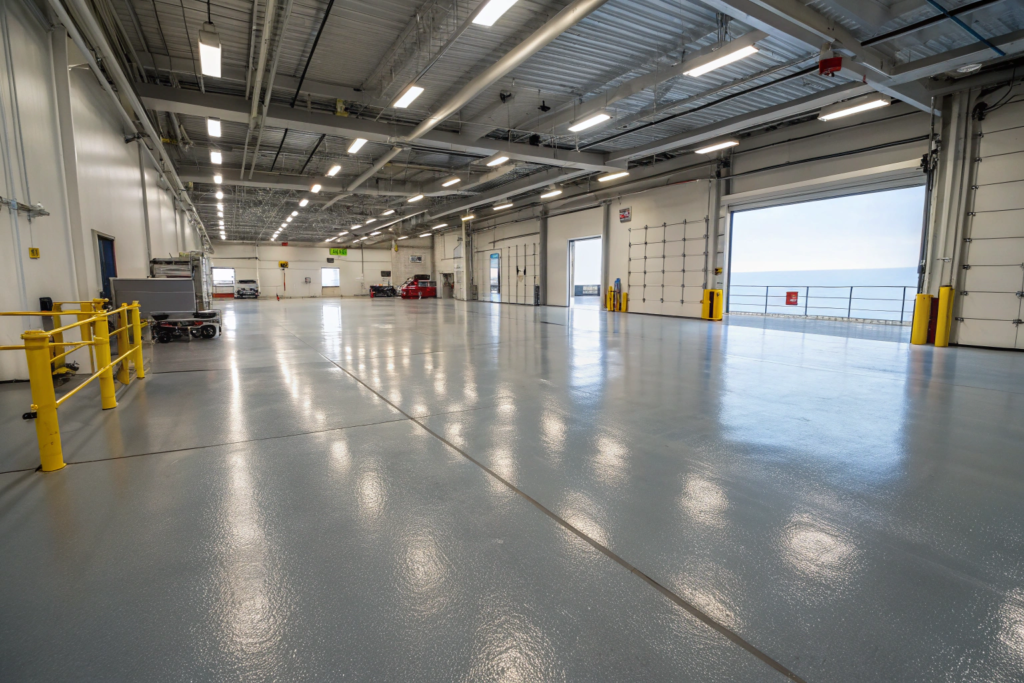
Year-Round Installation Considerations for Coastal Areas
Even the right product, applied by the right contractor, can fail if it goes down at the wrong time. Timing matters more in Warrawong than most people realise — and it’s one of the clearest signs of whether a contractor genuinely understands coastal epoxy flooring or not.
Temperature and Humidity Windows for Epoxy Installation in Wollongong
Most epoxy systems require conditions between 10°C–30°C and below 85% humidity. Wollongong’s January and February peaks regularly push outside safe application windows, particularly for coastal concrete coating work near the waterfront.
How Experienced Local Contractors Work Around Wollongong’s Climate
Contractors familiar with Warrawong, Fairy Meadow, and Port Kembla know which weeks to avoid and when dehumidification equipment is needed to control on-site conditions.
Planning Your Project Around Wollongong’s Wet Season
For residential clients, autumn is generally the most practical time to schedule epoxy garage floors Wollongong installations — humidity is dropping, temperatures are stable, and contractors have more scheduling flexibility than in the summer rush. Commercial and industrial clients with tighter timelines should discuss dehumidification options upfront, which allow installations to proceed outside ideal weather windows without compromising the finished result.
| Season | Conditions | Installation Suitability |
|---|---|---|
| Summer (Dec–Feb) | High humidity, heat peaks | Challenging — dehumidification often required |
| Autumn (Mar–May) | Stable, moderate humidity | Best window for most installations |
| Winter (Jun–Aug) | Cool, lower humidity | Good — watch for low overnight temperatures |
| Spring (Sep–Nov) | Variable, increasing humidity | Moderate — monitor conditions closely |
Ready to Get Your Warrawong Slab Tested?
Most epoxy quotes in Wollongong start with a look at the floor and a price. Ours start with a test.
Before we recommend any system, Local Epoxy Flooring Wollongong tests your slab for moisture vapour transmission — because in Warrawong’s coastal environment, that number determines everything. The product, the primer, the installation window. All of it flows from what the slab is actually doing.
Book Your Free Coastal Epoxy Assessment in Warrawong — We Test Your Slab Before We Quote Anything.
No obligation. No pushy sales calls. Just an honest assessment of your floor and what it actually needs.
We service Warrawong, Port Kembla, Fairy Meadow, Unanderra, and Wollongong CBD — and we respond to all enquiries within 2 business hours.
📞 Call Local Epoxy Flooring Wollongong today on 02 4202 6324

