
Marcus had his Berkeley garage floor coated three years ago. Looked great for about eighteen…
Port Kembla Climate Epoxy Flooring: What Every Site Manager Needs to Know
Gary from a Port Kembla warehouse facility rang us last February, frustrated. He’d had epoxy flooring installed six months earlier by a contractor from out of the area, and already the surface was bubbling near the roller doors. The installer had done the job in the middle of summer, hadn’t accounted for the humidity coming off the harbour, and used a standard formulation that wasn’t suited to coastal industrial environments. It was a $14,000 mistake that could’ve been avoided.
Port Kembla’s industrial precinct is one of the most demanding environments in New South Wales for floor coatings. The combination of salt air off the harbour, significant temperature swings between seasons, and high humidity levels means that not all epoxy systems perform the same way here. If you’re planning a flooring project in the area — whether it’s a warehouse near the steelworks, a processing facility, or a commercial workshop — understanding how the local climate affects epoxy performance isn’t just useful. It’s the difference between a floor that lasts 15 years and one that’s failing before the warranty kicks in.
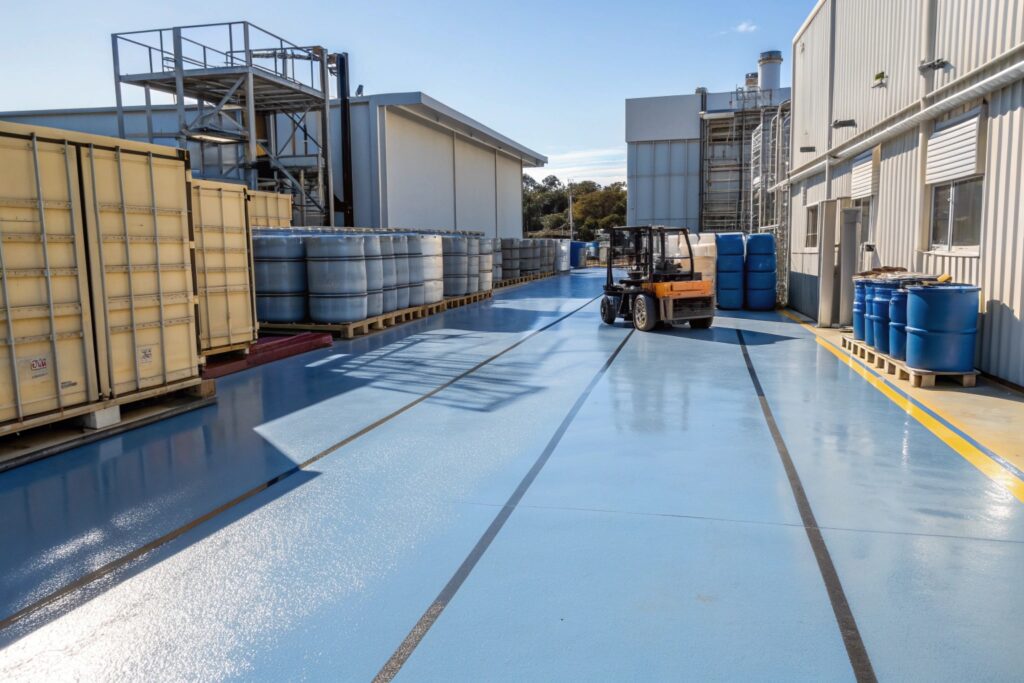
Temperature Fluctuations and Epoxy Expansion in Port Kembla
Port Kembla sits in a coastal industrial zone where summer temperatures can push past 35°C on the factory floor, particularly in steel and manufacturing facilities that generate their own heat. Come winter, those same floors can drop to 8-10°C overnight. That’s a swing of over 25 degrees, and epoxy flooring feels every single degree of it.
Epoxy is a rigid material. It bonds hard to the concrete substrate beneath it, and when temperatures rise, both the concrete and the epoxy coating expand — but not always at the same rate. If the coating system wasn’t formulated with thermal cycling in mind, or if the concrete substrate wasn’t properly prepared before application, that expansion and contraction stress builds up over time. The result is delamination, cracking along the joints, or that bubbling effect Gary was dealing with.
For Port Kembla facilities, the fix is selecting an epoxy system with a flexible additive or a polyurethane topcoat that can handle thermal movement without cracking. Some contractors use a broadcast quartz layer between coats to create a mechanical bond that holds through temperature stress. It’s not complicated — but it requires a contractor who actually knows the local conditions rather than applying a one-size-fits-all approach.
What to look for in a specification:
- Thermal cycling tolerance rated for coastal NSW conditions
- Polyurethane or polyaspartic topcoat for flexibility
- Expansion joint placement mapped before installation begins
- Concrete temperature checked at slab level before any coating is applied — not just ambient air temperature
Humidity Control During Installation in Coastal Areas
Port Kembla’s proximity to the harbour means humidity readings that would make an inland contractor nervous. On a typical summer morning, relative humidity in the area can sit above 80% before 9am. That’s a real problem for epoxy installation, because moisture is epoxy’s biggest enemy during the curing process.
When epoxy is applied to a surface with high ambient humidity, or to a concrete slab that’s drawing moisture up from below, the coating can’t cure properly. The moisture gets trapped between the epoxy layers and the concrete, and what you end up with is a condition called “blushing” — a cloudy, milky finish that looks bad and performs worse. In more severe cases, the coating simply fails to bond and peels away from the substrate within weeks of installation. This is exactly what catches out contractors who travel from inland areas and don’t adjust their process for coastal conditions.
Professional installers working in Port Kembla monitor dew point temperature alongside standard humidity readings. The rule of thumb is that the surface temperature of the concrete needs to be at least 3°C above the dew point before application begins. On humid coastal mornings, that window might only open up mid-morning, which means scheduling and timing the pour around local conditions rather than just showing up at 7am and cracking on.
Moisture vapour transmission from the slab itself is another issue specific to older industrial facilities near the waterfront. Concrete that’s been exposed to tidal groundwater movement can have elevated moisture content even when the surface feels dry to the touch. A moisture meter reading and a calcium chloride test before any coating work starts isn’t optional in this environment — it’s the only way to know what you’re actually working with.
Key humidity checkpoints before installation:
- Relative humidity below 85% at application time
- Dew point margin of at least 3°C between slab surface and dew point temperature
- Moisture vapour emission rate tested on older slabs near the harbour
- Consider a moisture-tolerant epoxy primer as a base layer on high-risk sites

UV Resistance for Outdoor Industrial Applications
Standard epoxy flooring and direct sunlight don’t get along. Most epoxy formulations are aliphatic-free, which means UV exposure causes them to yellow, chalk, and break down at the surface level over time. In an enclosed warehouse, that’s not much of a concern. But Port Kembla has a significant number of facilities with outdoor hardstand areas, loading docks exposed to the north and west, and roller door entries that cop direct afternoon sun for hours at a stretch.
The steel and logistics facilities around the Port Kembla precinct often have semi-covered areas — think hardstand yards, wash-down bays, and receival zones — where the floor coating needs to handle both UV exposure and the kind of heavy traffic that comes with forklifts, shipping containers, and industrial vehicles. Apply a standard epoxy system to these areas and within 12-18 months you’re looking at a chalky, degraded surface that’s lost its slip-resistance properties and looks like it hasn’t been maintained.
The solution that works consistently in Port Kembla’s conditions is a polyaspartic or aliphatic polyurethane topcoat over the epoxy base. These products are UV-stable, meaning they hold their colour and surface integrity even with prolonged sun exposure. They also cure faster than standard epoxy topcoats, which matters in an environment where you need to get operations back up and running quickly. SafeWork NSW guidelines on slips, trips and falls in the workplace outline the slip-resistance requirements that apply to industrial floor surfaces — and a degraded epoxy topcoat that’s lost its aggregate grip won’t meet those standards.
For outdoor hardstand areas that take vehicle traffic, a UV-stable coating with an anti-slip aggregate broadcast into the surface is the practical standard. It handles the sun, the salt air, and the mechanical wear simultaneously.
Where UV resistance matters most on Port Kembla sites:
- Loading dock aprons with western or northern exposure
- Wash-down bays with partial roof coverage
- Roller door entries and transitional indoor/outdoor zones
- Chemical storage areas with skylights or open-air sections
Seasonal Installation Considerations for Port Kembla Sites
Timing an epoxy flooring project in Port Kembla isn’t just about when it suits the business schedule. The season you install in directly affects how the coating cures, how long it takes, and how well it performs over its lifetime. Get the timing wrong and you’re fighting the climate the entire way through the job.
Summer installations come with the humidity challenges already covered, but there’s another layer to it in Port Kembla specifically. December through February brings afternoon storms off the Tasman that can roll in fast, spiking humidity by 20-30% within an hour. If a coating is mid-cure when that happens, the sudden moisture exposure can cause surface defects that aren’t immediately visible but show up as delamination six months down the track. Experienced local contractors watch the Bureau of Meteorology climate data for the Wollongong region closely and build weather contingency into the schedule rather than hoping for the best.
Winter is often the underrated sweet spot for industrial epoxy work in this region. Temperatures are cooler and more stable, humidity tends to be lower, and the dramatic afternoon storm pattern eases off. The trade-off is that epoxy cures more slowly in cold conditions — below 10°C at slab level, many standard systems won’t cure correctly at all. A contractor who knows the Port Kembla environment will use a low-temperature hardener formulation during winter months and allow extended cure times before the floor goes back into service.
Autumn — March through May — is genuinely the most consistent window for epoxy installation in this area. Temperatures are moderate, humidity is dropping off from the summer peak, and the concrete slab temperatures are still warm enough to support normal cure rates. If there’s any flexibility in a project timeline, pushing the installation into this window is worth the wait.
Seasonal installation snapshot for Port Kembla:
| Season | Conditions | Considerations |
| Summer | High humidity, storm risk | Dew point monitoring, weather contingency planning |
| Autumn | Moderate, stable | Best overall window for installation |
| Winter | Cool, lower humidity | Low-temp hardener required, extended cure times |
| Spring | Variable, increasing humidity | Monitor moisture levels, avoid late-spring storms |
Long-term Performance Data in Port Kembla Conditions
A well-specified epoxy floor installed correctly in Port Kembla should last 10-15 years in a standard industrial environment before it needs a full recoat. That’s the benchmark. But “well-specified” and “installed correctly” are doing a lot of work in that sentence, because the local conditions here will expose every shortcut and every wrong product choice faster than they would in a less demanding environment.
The facilities that get the best long-term results in this precinct share a few common characteristics. They used a contractor with direct experience in coastal NSW industrial environments. They didn’t cut the surface preparation short — mechanical grinding to the correct concrete surface profile, rather than just acid etching, is standard for Port Kembla sites where moisture and chemical exposure are ongoing. And they invested in a proper topcoat layer rather than treating the epoxy base as the finished surface.
Salt air is the slow killer that most facility managers underestimate. It doesn’t damage epoxy overnight, but the salt particles that settle on a surface with micro-cracking or pinhole voids work their way into the coating system over time and accelerate breakdown from below. Facilities within 500 metres of the harbour waterfront — and there are plenty of them in the Port Kembla precinct — see this effect more than sites further inland. A sealed, high-build topcoat with no pinhole voids is the only reliable defence.
Annual maintenance inspections make a measurable difference to long-term performance. Catching a small area of delamination early and spot-repairing it costs a fraction of what a full recoat does. Facilities that treat their epoxy floor as a set-and-forget installation typically find themselves looking at a full replacement well before the 10-year mark.
Indicators that a Port Kembla epoxy floor is performing well:
- No delamination or bubbling at roller door entries after 12 months
- Consistent surface colour without yellowing or chalking in sun-exposed zones
- Slip-resistance aggregate still providing grip in wet conditions
- No moisture-related blistering near the perimeter walls or drainage points
Get the Right Epoxy Flooring Advice for Your Port Kembla Facility
Port Kembla’s climate isn’t forgiving to flooring systems that weren’t designed for it. The humidity off the harbour, the temperature swings through the seasons, the salt air, the UV exposure on outdoor hardstand areas — these aren’t minor variables. They’re the defining factors in whether your epoxy floor delivers a decade of reliable service or starts failing before the first annual review.
The difference between a floor that lasts and one that doesn’t usually comes down to one decision made at the start — choosing a contractor who actually understands the local environment rather than one who treats every site the same regardless of where it is. Ask about their experience with coastal NSW installations. Ask what moisture testing they do before application. Ask what topcoat system they’re specifying and why. The answers will tell you everything you need to know.
If you’re planning an epoxy flooring project in the Port Kembla area and want advice from a team that knows the Illawarra industrial market, get in touch for a no-obligation site assessment. We’ll look at your specific facility conditions, your operational schedule, and give you a straight answer on what system suits your site — and what it’ll realistically cost.
Call us today or fill in our online enquiry form to book your free site assessment.

