
Marcus had his Berkeley garage floor coated three years ago. Looked great for about eighteen…
Coastal Epoxy Flooring Port Kembla | Salt Air Resistant
If you’ve got a warehouse, garage, or industrial facility near the Port Kembla waterfront, you already know what the ocean air does to everything it touches. Metal rusts faster. Paint peels earlier. And floors that looked fine twelve months ago are now showing signs of deterioration that nobody budgeted for. It’s a real problem in this part of the Illawarra, and it costs local businesses more than they realise.
The good news is that coastal epoxy flooring Port Kembla property owners are turning to is specifically designed to hold up against exactly these conditions — the salt-laden air, the humidity, the ground moisture that comes with being this close to the water. But not all epoxy is created equal, and knowing what to look for makes the difference between a floor that lasts a decade and one that needs ripping up in three years.
How Salt Air Damages Traditional Flooring in Port Kembla
Port Kembla sits right on the coast, and the combination of industrial activity, sea breeze, and humidity creates an environment that’s genuinely harsh on flooring. Standard concrete coatings and basic floor paints weren’t engineered with this in mind — and they show it.
Salt air is the main culprit. When sodium chloride particles settle into microscopic surface cracks and pores in a floor coating, they draw in moisture. That moisture expands and contracts with temperature changes, and over time it breaks down the bond between the coating and the substrate underneath. What starts as a small blister or patch of peeling can spread quickly across an entire floor section.
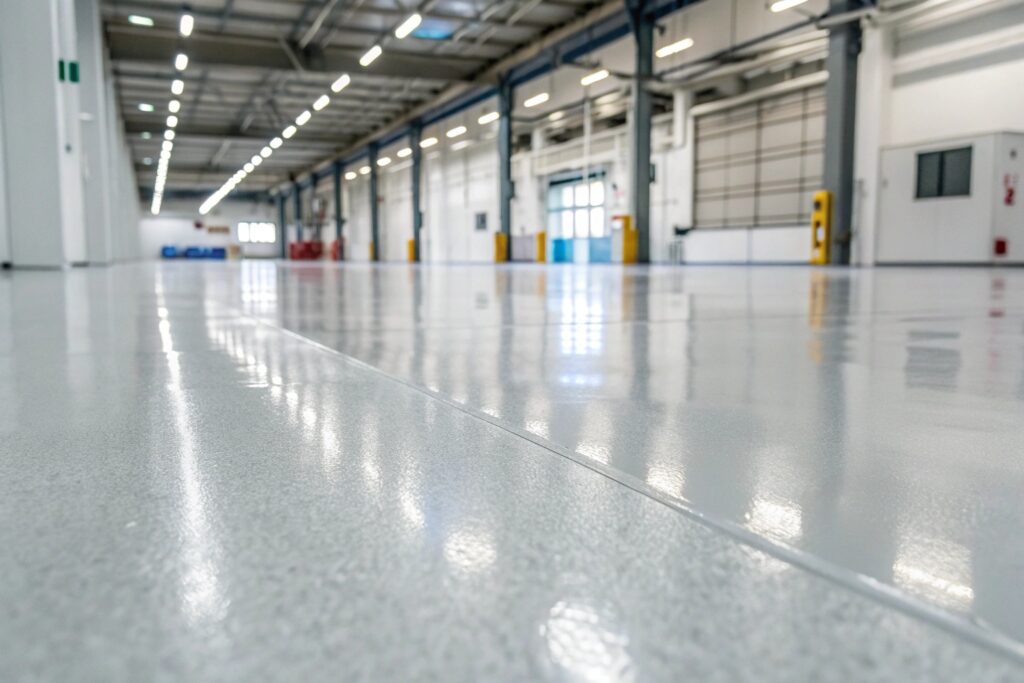
The Humidity Factor
Wollongong and the Port Kembla area average relative humidity levels that sit comfortably above what you’d find inland. For flooring, high ambient humidity during installation is one of the most common reasons coatings fail prematurely. If the surface moisture content of the concrete slab is too high when the epoxy goes down, the coating can’t bond properly — and you end up with delamination within months, not years.
What Happens to Unprotected Concrete
Bare concrete in a coastal industrial environment absorbs salt and moisture like a sponge. Once that process starts, you get:
- Surface spalling and pitting that worsens with forklift traffic
- Efflorescence — the white powdery deposits that appear as salts migrate to the surface
- Structural weakening over time in severe cases
- Ongoing dust and debris that creates safety and hygiene issues
Traditional floor paints simply don’t have the chemical resistance or film thickness to stop this process. They’re fine for low-exposure environments, but Port Kembla’s proximity to the harbour and the BlueScope steelworks creates a different level of airborne contamination that standard products can’t handle long term.
Specialised Coastal Epoxy Formulations for Marine Environments
Not every epoxy product on the market is suitable for coastal conditions. The formulations that perform well near Port Kembla are specifically engineered with marine and industrial exposure in mind — and there are a few key differences worth understanding before you commit to a contractor or a product.
High-Build Epoxy Systems
Standard epoxy coatings are applied at around 250-300 microns dry film thickness. In a coastal industrial setting, that’s often not enough. High-build systems go on at 500 microns or more, creating a thicker barrier that salt air and moisture have to work much harder to penetrate. For warehouses and facilities near the waterfront, this isn’t an optional upgrade — it’s the baseline.
Moisture-Tolerant Primers
One of the most important components in a coastal epoxy system is what goes on first. Moisture-tolerant epoxy primers are formulated to bond to concrete slabs with higher residual moisture content — which is exactly what you’re dealing with in this part of the Illawarra. A standard primer applied to a damp slab is a recipe for delamination. The right primer changes that outcome completely.
Chemical and Salt Resistance
Marine-grade epoxy formulations include resins that resist chloride ion penetration — the specific mechanism by which salt breaks down conventional coatings. When comparing products, look for:
- Chloride resistance ratings relevant to marine environments
- UV-stable topcoats that won’t yellow or degrade from sunlight exposure near roller doors and loading docks
- Anti-carbonation properties that protect the concrete substrate beneath the coating
- Low VOC options where indoor air quality matters for staff working in the space
Polyurethane Topcoats for Added Protection
Many quality coastal installations finish with a polyurethane topcoat over the epoxy base. Polyurethane adds an extra layer of abrasion and chemical resistance, and it handles the thermal cycling that comes with coastal environments — warm days, cooler nights, and the temperature swings near large roller door openings — without cracking or lifting.
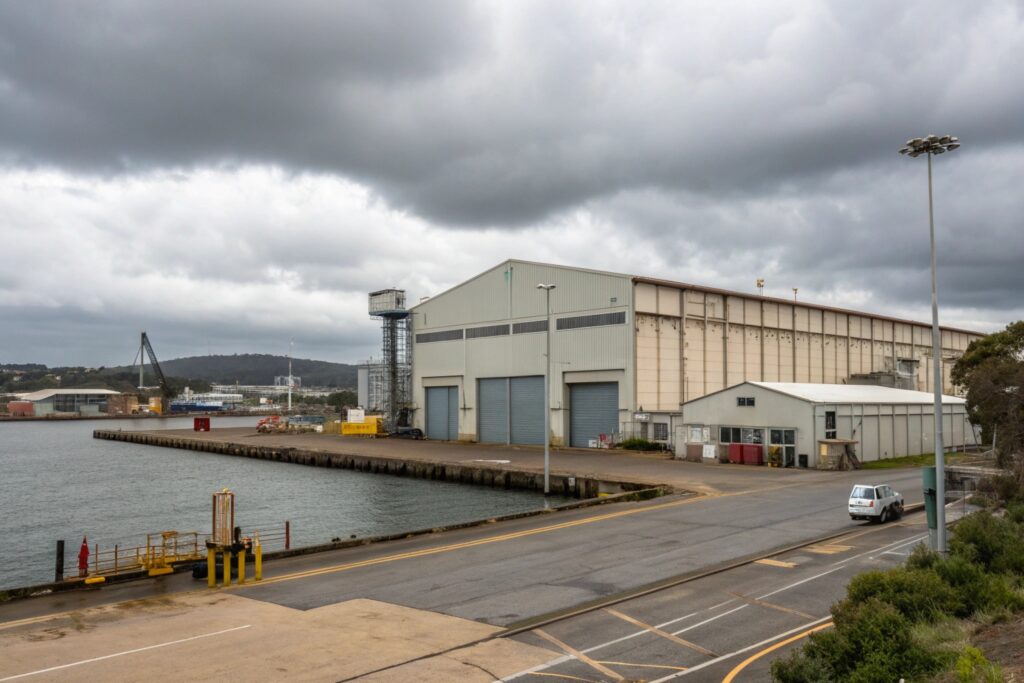
Moisture Resistance Testing in High Humidity Conditions
Before any epoxy goes down in a Port Kembla facility, moisture testing isn’t optional — it’s the step that determines whether the whole job succeeds or fails. This is where a lot of cheaper installations cut corners, and it’s exactly where problems start.
How Moisture Testing Works
The AS 1884 moisture testing standard sets out the requirements for concrete moisture testing before floor coating applications in Australia. A reputable contractor will carry out one or more of the following tests before touching a single tin of primer:
- Calcium chloride test — measures the rate of moisture vapour emission from the slab surface over 60-72 hours
- Relative humidity probe testing — drilled into the slab at depth to get an accurate moisture reading from within the concrete, not just the surface
- Plastic sheet test — a basic site check that gives a quick indication of surface moisture before more detailed testing
Each method gives different information, and in a coastal environment where ground moisture levels are consistently higher than inland locations, using more than one approach gives a clearer picture of what you’re actually dealing with.
Why This Matters More Near the Coast
Concrete slabs in Port Kembla and surrounding industrial areas are often sitting on ground that’s influenced by tidal movement, high water tables, and decades of industrial activity. Moisture doesn’t just come from rain — it wicks up through the slab from below, a process called rising damp. Without the right primer system and moisture barrier, even a perfectly applied epoxy coating will eventually fail from underneath.
What Happens When Testing Gets Skipped
A facility manager who’s been through a failed epoxy installation will tell you the same thing — it looked fine for the first few months, then the blistering started. By the time it’s visually obvious, the damage is already done across a large area. Stripping back a failed coating, re-preparing the surface, and reapplying is significantly more expensive than getting the moisture testing right the first time.
Port Kembla Case Studies: Coastal Epoxy Performance
The proof of any flooring system is how it holds up after years of real-world exposure — not just how it looks on installation day. Across the Port Kembla and broader Wollongong industrial precinct, properly specified coastal epoxy systems have consistently outperformed standard coatings in tracked comparisons.
Warehouse Facilities Near the Harbour
A logistics facility within a kilometre of the Port Kembla harbour had gone through two standard epoxy installations in five years — both failing within 18 months due to moisture-related delamination. A third installation using a moisture-tolerant primer, high-build epoxy system, and polyurethane topcoat has now been in service for over three years with no signs of failure. The difference wasn’t the applicator — it was the product specification.
Industrial Workshops with Heavy Traffic
Workshops operating near the steelworks face a combination of salt air, chemical exposure, and constant forklift and machinery traffic. Marine-grade epoxy systems in these environments regularly hit the five-to-seven year mark before requiring any maintenance attention — compared to standard coatings that often show significant wear within two years under the same conditions.
Maintenance Requirements for Coastal Industrial Floors
A good coastal epoxy installation doesn’t look after itself entirely — but the maintenance it does need is straightforward and far less costly than repairing a failing floor.
Routine Cleaning
Salt residue and industrial grime should be removed regularly with a pH-neutral cleaner. Avoid acidic or solvent-based cleaners that can break down the topcoat over time. A simple weekly sweep and monthly wash-down is enough for most industrial applications. SafeWork NSW flooring safety requirements also recommend regular maintenance programs that follow manufacturer instructions as part of an employer’s duty of care — something worth keeping in mind when scheduling your floor upkeep.
Annual Inspections
Once a year, it’s worth having the floor properly inspected — checking for any early signs of edge lifting, surface scratching through to the substrate, or areas where the topcoat has worn thin. Catching these early means a simple topcoat reapplication rather than a full system replacement.
Recoating Timelines
In coastal industrial environments, a quality epoxy system with a polyurethane topcoat typically needs a maintenance recoat every five to seven years depending on traffic levels. Facilities with lighter foot traffic can often push that timeline out further.
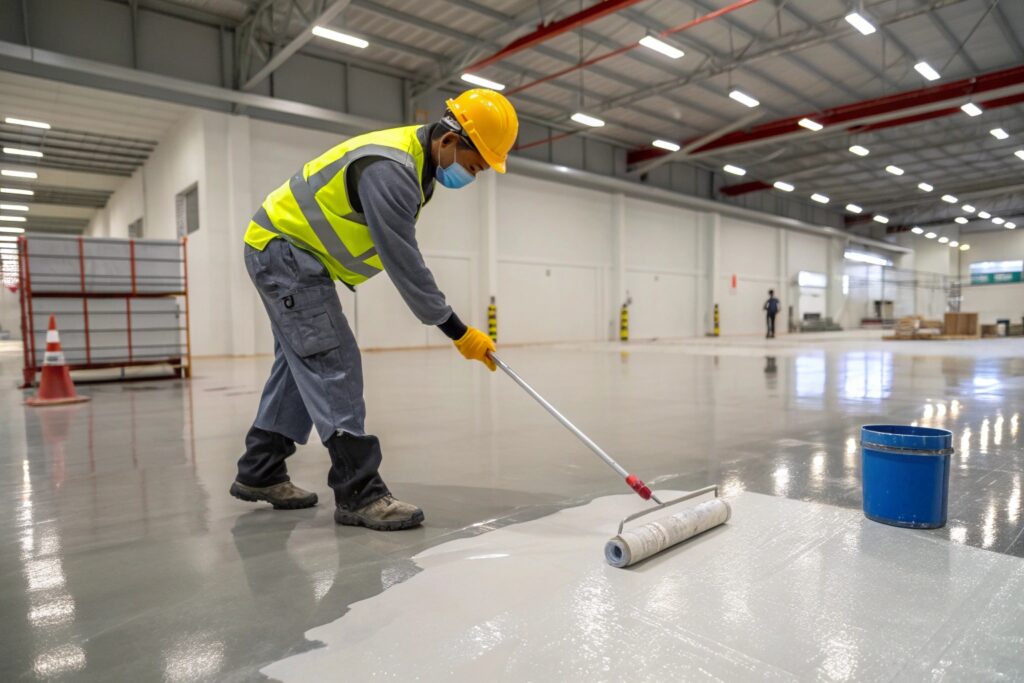
Get the Right Epoxy System for Port Kembla’s Conditions
If your facility is dealing with salt air, humidity, or moisture issues, getting the flooring specification right from the start saves significant money and downtime over the life of the floor. The wrong product in a coastal environment isn’t just a cosmetic problem — it’s an operational one.
Speak with a local epoxy flooring specialist who understands the specific conditions across the Port Kembla and Wollongong industrial precinct. A proper site assessment, moisture testing, and a product specification matched to your environment is what separates a floor that lasts from one that doesn’t.
Contact us today for an obligation-free assessment of your facility and a quote tailored to coastal conditions.

