
Marcus had his Berkeley garage floor coated three years ago. Looked great for about eighteen…
Epoxy Over Concrete Port Kembla
A facility manager at a Port Kembla warehouse called us not long ago, frustrated after spending weeks chasing quotes. His floor had an old painted coating — patchy, peeling in spots — and every contractor he’d spoken to either said “rip it all up” or just showed up, rolled on the epoxy, and left him with a bubbling mess six months later. He wasn’t alone. It’s one of the most common situations we see across the Illawarra’s industrial and commercial sector, and the answer isn’t as simple as yes or no.
So, can you install epoxy over existing painted or sealed concrete? Short answer — sometimes. But the real question is whether your existing surface is actually ready to bond with a new coating, and that comes down to preparation. Get it right, and you’ve got a floor that’ll handle forklifts, chemicals, and 10-hour shifts without flinching. Get it wrong, and you’re peeling epoxy off the floor six months from now and starting over. Here’s what Port Kembla facility managers and business owners need to know before they commit to a job.
Assessing Existing Concrete Surfaces in Port Kembla Facilities
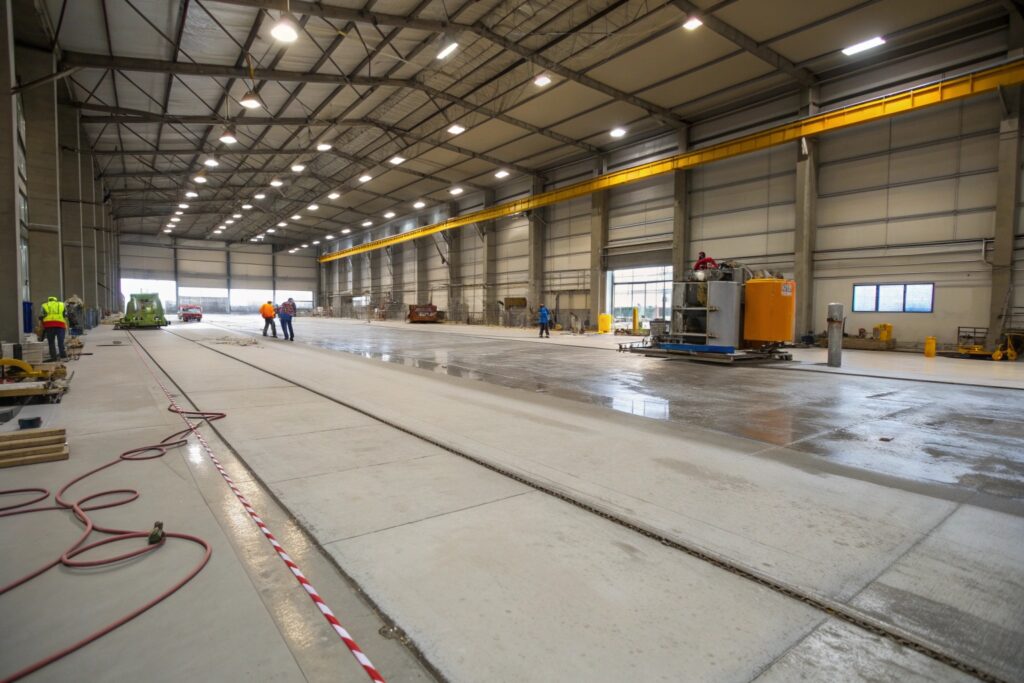
Port Kembla’s industrial environment throws a lot at concrete floors. You’ve got heavy machinery, chemical exposure, salt air drifting in from the harbour, and decades of use that can leave a slab in all kinds of condition. Before anyone quotes you on epoxy, the surface needs a proper assessment — not a quick glance and a handshake.
The first thing to look at is what’s already on the floor. Old paint, sealers, curing compounds, and previous epoxy coatings all behave differently under a new application. Some bond reasonably well if they’re still intact and properly adhered. Others — particularly old oil-based paints or moisture-trapped sealers — will cause a new coating to fail no matter how well it’s applied.
Key things to check during assessment:
- Adhesion of existing coating — Is it peeling, flaking, or lifting at the edges? If yes, it’s unlikely to support a new layer
- Moisture levels in the slab — Port Kembla’s proximity to the harbour means moisture vapour transmission is a genuine concern, especially in older facilities
- Oil and chemical contamination — Common in workshops and warehouses, this penetrates deep into concrete and prevents proper bonding
- Crack and joint condition — Existing cracks need treatment before any coating goes down
- Coating thickness — Multiple layers of old paint build up over time and create an unstable base
A proper assessment isn’t a five-minute job. It involves moisture testing, visual inspection, and often adhesion pull testing before any preparation plan is put together. Skipping this step is where most failed epoxy jobs in the region start.
Mechanical Preparation Methods for Industrial Floors
Once you know what you’re working with, preparation is where the real work happens. And in an industrial setting — whether that’s a Port Kembla warehouse, a manufacturing facility, or a logistics operation near the port — mechanical preparation is almost always the right call over chemical methods alone.
The goal is simple: you need the concrete surface to be clean, open, and profiled enough for the epoxy to grip. The Australian concrete surface preparation standards set out by the Concrete Institute of Australia define the surface profile requirements for different coating systems — and in an industrial setting, meeting those standards isn’t something you can cut corners on. Think of it like painting a wall that’s been covered in grease and gloss — you can’t just roll over it and hope for the best.
The main mechanical preparation methods used on industrial floors:
- Shot blasting — The industry standard for large commercial and industrial floors. A machine propels steel shot across the surface at high speed, removing old coatings, opening the concrete pores, and leaving a consistent surface profile. It’s fast, effective, and produces minimal dust with the right equipment
- Diamond grinding — Better suited to areas where shot blasting can’t reach, or where the surface needs a finer profile. Common around columns, edges, and doorways
- Scarifying — A more aggressive method used when coatings are thick or heavily bonded. It removes material quickly but leaves a rougher profile that needs further attention
- Captive blasting — A contained version of shot blasting that’s useful in areas where dust and debris need to be controlled, particularly in food-grade or sensitive environments
The right method — or combination of methods — depends on what’s on the floor, the condition of the concrete underneath, and the epoxy system going down on top. A standard garage floor and a BlueScope-adjacent facility servicing heavy chemical exposure are very different jobs, and they shouldn’t be treated the same way.
One thing worth knowing: mechanical preparation generates noise, dust, and some disruption. For Port Kembla operations running tight schedules, this needs to be factored into the project plan from the start — not worked out on the day.
When to Remove vs. Prepare Existing Coatings
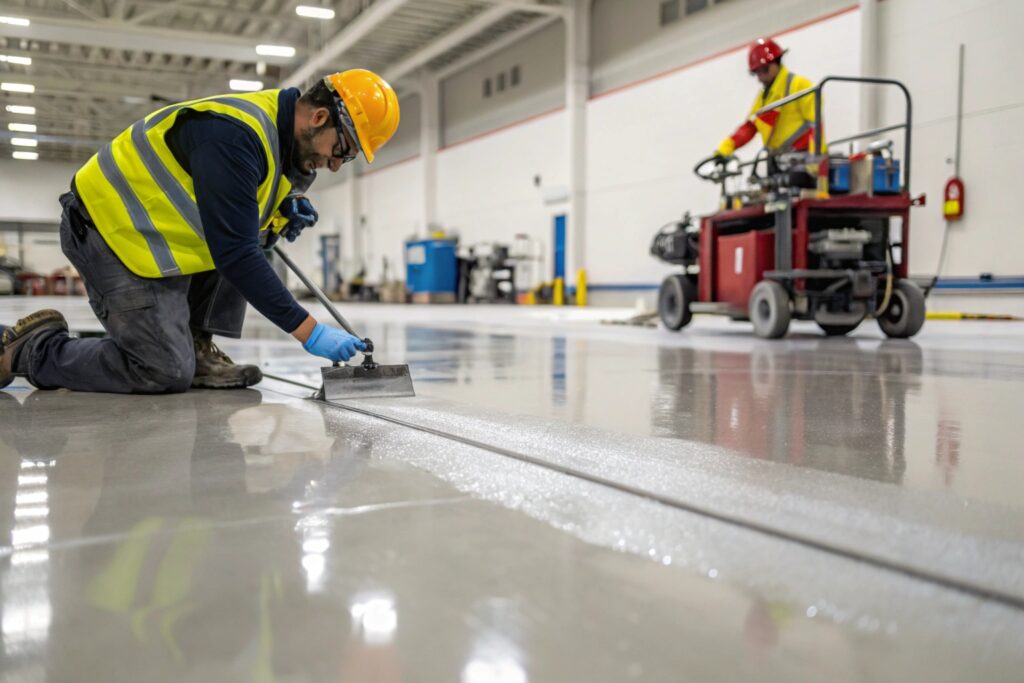
This is the decision that separates a good epoxy job from an expensive mistake. Not every existing coating can be prepared in place — some need to come off entirely before anything new goes down. Knowing which situation you’re dealing with saves time, money, and a whole lot of headaches down the track.
As a general rule, preparation in place works when the existing coating is still well-bonded, thin enough to profile through, and free from contamination. Full removal is the better path when the coating is failing, heavily built up, or sitting over concrete that has moisture or chemical issues underneath.
Situations where full removal is the right call:
- The existing coating is peeling, bubbling, or delaminating in multiple areas
- There are several layers of old paint or sealer that have built up over years of recoating
- Oil or chemical contamination has penetrated through the coating into the concrete itself
- Moisture vapour readings are high — applying epoxy over a moisture-affected slab without addressing the source is a guaranteed failure
- The previous coating was applied incorrectly and never properly bonded to begin with
Situations where preparation in place can work:
- The existing coating is a single, well-adhered layer with no signs of lifting
- Surface contamination is limited to the top layer and hasn’t penetrated the concrete
- Adhesion testing confirms the existing coating is holding firmly
- The coating type is compatible with the new epoxy system being applied
For Port Kembla’s older industrial facilities — some of which have been operating for decades — full removal is more common than people expect. Years of repainting, chemical spills, and heavy use leave floors in a condition that preparation alone can’t fix. It’s not the answer anyone wants to hear when they’re watching the project budget, but putting a new epoxy system over a compromised base is a short-term fix that becomes a much bigger cost later.
Adhesion Testing for Critical Industrial Applications
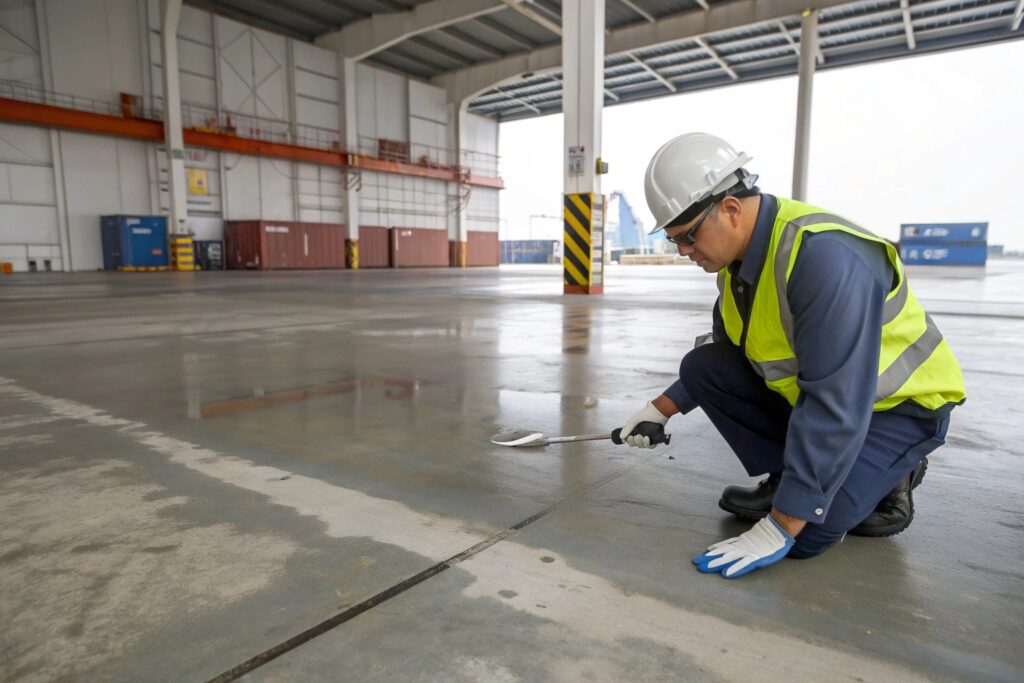
Before any epoxy goes down in a high-stakes industrial environment, adhesion testing takes the guesswork out of the equation. It’s a straightforward process that gives you hard data on whether your existing surface — or the concrete underneath — is actually going to hold a new coating under real working conditions.
For Port Kembla facilities dealing with heavy machinery, chemical exposure, or compliance requirements, this step isn’t optional. A floor that fails in a warehouse running 24-hour operations isn’t just an inconvenience — it’s a safety issue, a WorkSafe NSW concern, and a significant business disruption.
The two most common adhesion testing methods used on industrial floors:
- Pull-off testing — A small dolly is bonded to the surface and a controlled force is applied to pull it free. The result tells you exactly how much force the surface can withstand before failing, and whether that failure happens at the coating, the bond line, or within the concrete itself. Results are measured in megapascals (MPa) and compared against the minimum threshold required for the epoxy system being applied
- Tape and cross-hatch testing — A quicker, less technical method used for initial screening. A grid pattern is cut into the existing coating and adhesive tape is applied and pulled back sharply. Useful for getting a read on surface adhesion before committing to full pull-off testing
What the results actually tell you:
| Result | What It Means |
| Failure within existing coating | Coating needs full removal |
| Failure at bond line | Surface preparation is insufficient |
| Failure within concrete substrate | Concrete itself may be structurally compromised |
| Pass at required MPa threshold | Surface is ready for epoxy application |
For critical applications — chemical processing areas, food manufacturing floors, or anywhere WorkSafe compliance is being assessed — adhesion testing results should be documented and kept on file. The WorkSafe NSW compliance requirements for industrial flooring are clear that floor surfaces in high-risk environments need to meet specific performance standards, and having your adhesion test results on record is the kind of due diligence that protects both the contractor and the facility operator if questions arise down the track.
Cost Comparison: Preparation vs. Concrete Replacement
When a floor assessment comes back with bad news, the first instinct is often to ask whether replacing the concrete entirely might actually be cheaper. It’s a fair question — and for Port Kembla facility managers trying to justify capital expenditure, it deserves a straight answer.
In most cases, proper preparation and epoxy application is significantly more cost-effective than full concrete replacement. But “most cases” isn’t all cases, and understanding where the numbers fall helps you make a decision based on facts rather than whoever gives you the cheapest quote on the day.
Typical cost considerations for each path:
| Factor | Surface Preparation + Epoxy | Full Concrete Replacement |
| Upfront cost | Lower — prep and coating only | Higher — demolition, disposal, new pour, cure time, then coating |
| Downtime | 2-5 days depending on system | 2-4 weeks minimum |
| Disruption to operations | Manageable with staging | Significant — often full facility shutdown |
| Lifespan of result | 10-20 years with correct prep | 20-30 years for new slab |
| Risk of failure | Low with proper preparation | Very low |
| Best suited for | Structurally sound concrete with surface issues | Severely damaged or structurally compromised slabs |
The hidden cost that most people don’t factor in is downtime. For a Port Kembla warehouse or manufacturing operation, shutting down for three weeks while a new slab is poured and cured is a far bigger expense than the concrete work itself. Lost production, delayed orders, and staff disruption add up fast — and that rarely makes it into the contractor’s quote.
Where full replacement starts to make sense is when the concrete substrate itself is compromised. If pull-off testing reveals the concrete is failing structurally, or if there’s significant cracking, subsidence, or heaving across the slab, putting an epoxy system over the top is just delaying the inevitable. A good contractor will tell you this upfront rather than take your money and leave you with a floor that fails in 18 months.
For most Port Kembla industrial and commercial facilities, the answer is thorough preparation followed by the right epoxy system for the environment — not replacement. It’s the option that protects the budget, minimises downtime, and delivers a floor that performs under real industrial conditions.
Ready to Get Your Port Kembla Floor Done Right?
Getting epoxy over concrete right the first time comes down to honest assessment, proper preparation, and choosing a contractor who understands the difference between a floor that looks good on day one and a floor that’s still performing five years later.
If you’ve got an existing painted or sealed concrete floor at your Port Kembla facility and you’re not sure whether it can be prepared in place or needs full removal, the best starting point is a proper on-site assessment — not a quote based on photos.
Get in touch with our team today to book your assessment and find out exactly what your floor needs before any work begins.

