
Marcus had his Berkeley garage floor coated three years ago. Looked great for about eighteen…
Thermal Expansion Epoxy Flooring Coastal: What Primbee Homeowners Need to Know
Dave had done everything right.
Hired a decent crew, paid for a mid-range epoxy system, watched them work over two days in late autumn. The floor looked unreal — smooth, glossy, exactly what he’d pictured. His wife even commented on it, which if you know anything about home reno, means you actually nailed it.
Then summer hit.
By January, there was a hairline crack running almost the full width of the slab. By March, it had a mate. Come winter, the coating near the wall edges had started to lift — just enough to catch your toe on a dark morning and remind you something had gone wrong.
Turns out Dave’s an engineer. Which made the whole thing more frustrating, not less. When he finally called a local applicator to take a look, the answer was straightforward: thermal expansion. The concrete moved. The coating didn’t.
If you’re in Primbee or anywhere along the Illawarra coast, this is exactly the scenario you want to avoid before committing to an epoxy floor. Coastal climates swing harder than people realise — humidity cycles, temperature shifts, salt air — all of it puts real mechanical stress on surface coatings over time.
Thermal expansion is one of the least-discussed factors in residential epoxy work. And one of the most common causes of premature failure. Here’s what you need to know before anyone pours a drop of resin on your slab.
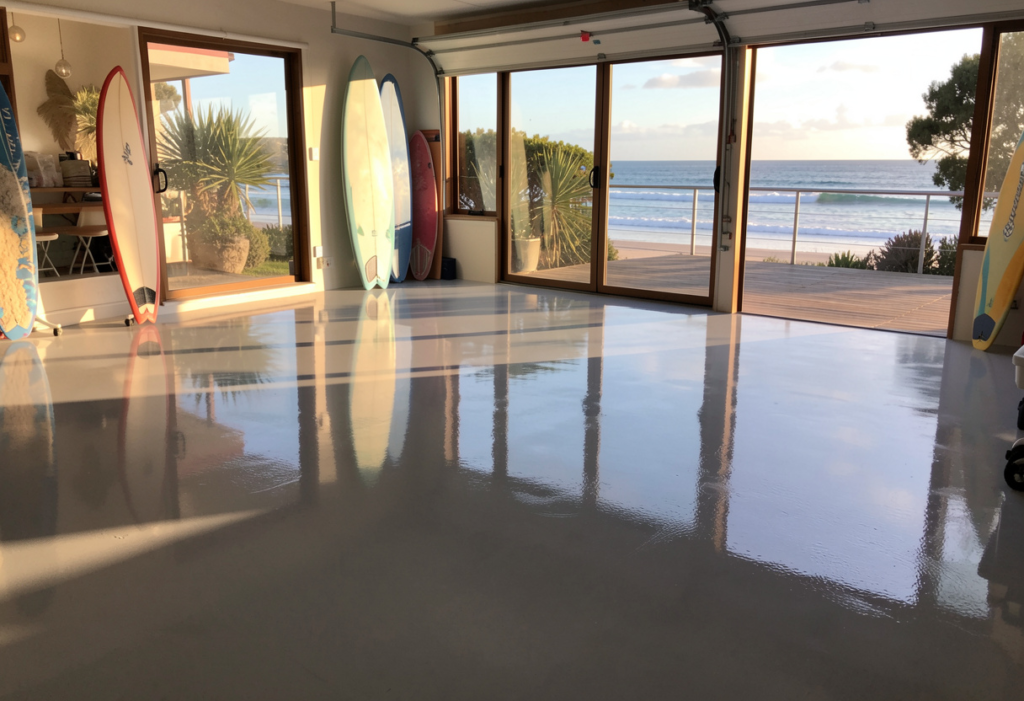
Understanding Temperature Fluctuations in Coastal Areas
Most people think living near the water keeps things mild. And in some ways it does — you’re not getting the 40-degree scorchers that bake western Sydney in February. But coastal climates like Primbee‘s have their own thermal challenge: consistency of cycling.
What that means in plain terms is your slab heats up and cools down. Every single day. The concrete expands in the afternoon heat, contracts overnight, and does it again tomorrow. It’s not dramatic — we’re talking millimetres — but over hundreds of cycles across seasons, that repeated movement adds up.
A few things make the Illawarra coast particularly active in this regard:
- Dark concrete absorbs more heat — an uninsulated garage slab in full sun can reach surface temperatures well above the ambient air temperature in summer
- Night-time drops are steeper near the water — the ocean moderates daytime highs but doesn’t hold heat the same way inland areas do after dark
- Humidity amplifies stress — moisture getting into micro-pores of concrete during cooler periods then expanding as temps rise adds another layer of movement beneath the coating
- Seasonal swings between winter lows and summer highs in the Illawarra can span 25–30°C — enough to cause measurable dimensional change in a full garage slab
Concrete expands roughly 10–12 microns per metre for every degree Celsius of temperature rise. A standard 6-metre garage slab can shift nearly 2mm across its length on a hot summer day. If your epoxy coating can’t flex with that movement, it will eventually crack or delaminate — it’s physics, not bad luck.
Flexible Epoxy Systems for Thermal Movement
Not all epoxy is created equal — and this is where a lot of homeowners get caught out.
Standard epoxy coatings are rigid. That’s actually part of what makes them durable under foot traffic and loads. But rigidity is exactly the wrong property when your substrate is moving. A coating that can’t flex will eventually lose the fight against a slab that’s doing its daily expansion routine.
The systems designed for coastal and temperature-variable environments work differently in a few key ways:
- Polyaspartic topcoats cure with more flexibility than standard epoxy and handle UV and temperature fluctuation significantly better — they’re worth the price premium in coastal applications
- Polyurethane mid-coats are sometimes layered between the base epoxy and topcoat to introduce a flexible membrane that absorbs slab movement before it reaches the surface
- Moisture-tolerant primers designed for coastal slabs seal the concrete properly before any coating goes down — skipping this step is one of the most common reasons systems fail in humid environments like Primbee
The thickness of the system matters too. Thicker builds — typically 2–3mm total — distribute stress better than thin single-coat applications. A single broadcast coat that looks great on day one has very little tolerance for movement.
When you’re getting quotes, ask specifically whether the system is rated for thermal cycling. Any applicator worth dealing with should be able to tell you the elongation rating of the products they’re using — that’s the percentage a cured coating can stretch before it cracks. For coastal applications, you want something in the range of 20–40% elongation minimum.
If they can’t answer that question, keep looking.
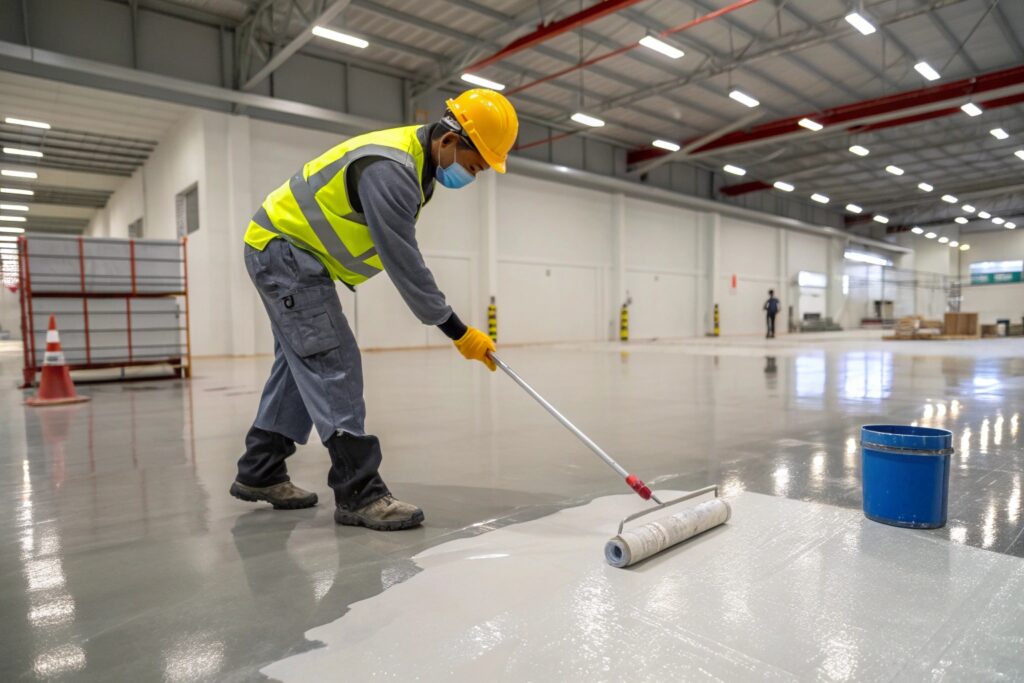
Preventing Cracking in Temperature-Variable Environments
Flexible products help. But the prep work underneath is what actually prevents cracking long-term.
Concrete surface profile matters more than most homeowners realise. The ICRI CSP scale rates surface roughness from 1 to 10 — for epoxy systems in thermally active environments, you want a CSP of 3 to 4 minimum. That mechanical tooth gives the coating something to grip when the slab tries to move away from it.
A few other things that make a real difference:
- Crack injection before coating — existing hairline cracks need to be filled with a flexible polyurethane filler, not rigid epoxy. Coating over an untreated crack just hides the problem until it telegraphs straight through your new floor
- Proper substrate drying — moisture content in the slab should be tested before application, not assumed. Primbee’s water table and coastal humidity means slabs hold moisture longer than inland sites
- Avoiding application in temperature extremes — epoxy applied to a slab above 30°C or below 10°C cures differently and bonds less reliably. Good applicators schedule around this
The slab and the coating need to move as partners, not opponents.
Joint Systems for Large Coastal Floor Areas
Here’s something that doesn’t come up enough in residential conversations: control joints.
In commercial and industrial flooring in Primbee, movement joints are standard practice. In residential work, they’re often skipped — either to save time, keep costs down, or because the applicator doesn’t think a domestic garage warrants the extra step.
For coastal homes, that thinking is wrong.
Any slab over about 40 square metres benefits from deliberate joint placement in the coating system. These aren’t ugly gaps — when done properly they’re clean, tight lines that give the floor somewhere to move without cracking through the middle of your beautiful finish.
A few things to know:
- Existing saw cuts in the concrete should never be filled and coated over — they exist for a reason and need to be honoured in the epoxy system with a flexible joint filler
- Cove joints at wall edges are particularly important in coastal environments where moisture migration from the perimeter is common
- Polyurethane sealants used in joints need to be compatible with the coating system — mismatched products can cause adhesion failure along the joint line
Ask your epoxy applicator how they handle existing control joints before work starts. It’s a simple question that tells you a lot about their experience.

Seasonal Maintenance for Thermal Stress Management
The right system, properly installed, doesn’t need a lot of attention. But a bit of seasonal awareness goes a long way toward protecting your investment.
Summer:
- Avoid parking a hot vehicle directly on the floor immediately after driving — let it cool on the driveway first. Tyre contact points concentrate heat and can soften topcoats over time
- Keep the garage ventilated during peak heat to reduce surface temperature spikes
Winter:
- Check joint lines and perimeter edges after the first cold snap — this is when any weak adhesion points will show themselves early, while they’re still easy to address
- Don’t use harsh chemical degreasers on the floor during cold months when the coating is at its most contracted and least flexible
Year-round:
- Wash the floor with a pH-neutral cleaner — acids and strong alkalines degrade the coating chemistry over time
- If you notice a hairline crack appearing, address it early with a compatible flexible filler before moisture gets underneath
Epoxy floors in coastal environments aren’t high maintenance. But they do reward a bit of attention across the seasons. Think of it less like a chore and more like checking in on something you’ve invested good money in — which, if you’ve done everything else right, should be looking sharp for a decade or more.


Comments (0)